Neck skin care often stops at the jawline, and the chest is easy to forget. Here is why both show sun damage, how to extend your routine below the jaw, what neck creams can and can't do, and which spots to check.
Why do the neck and chest show sun damage?
Sun-related skin ageing (photoageing) shows on the most exposed skin, such as the face, neck and arms, as roughness, wrinkles, uneven colour and small visible blood vessels. DermNet — Skin ageing Over the years, UV radiation breaks down the collagen and elastin fibres in skin, so it loses its elastic quality. DermNet — Solar elastosis
Pigmentation on the neck can follow the sun, too. Reddish-brown patches on the sides of the neck that spare the shaded skin under the chin are a common pattern called poikiloderma of Civatte, and perfumes may add to it. DermNet — Poikiloderma of Civatte Brown sun spots are common on the upper body. They are harmless, but some skin cancers look similar. DermNet — Solar lentigo
How do I extend my neck skin care below the jaw?
Cancer Council recommends a broad-spectrum, water-resistant SPF 50 or 50+ sunscreen every day the UV index is forecast to reach 3 or above. Use about a teaspoon for your face, neck and ears, and more for any chest your neckline leaves bare. Apply it 20 minutes before going outside, reapply at least every two hours outdoors, and wear a broad-brim hat, which shades the neck and ears. Cancer Council — Preventing skin cancer
Tops with collars cover more skin, and tightly woven linen or cotton protects while keeping you cool. Cancer Council — Sun protective clothing
- Take your moisturiser down your neck and onto your chest.
- Test a new product on your inner arm first, twice a day for two weeks, and skip it if a rash appears. Fragrance allergy is common, and in women it often shows on the neck. DermNet — Fragrance allergy
Our spring skincare review covers the rest of your routine.
What can a neck cream do, and what can't it?
In Australia, cosmetics can only claim to change how skin looks or smells, keep it clean and in good condition, or protect it. So on a cosmetic, "firming" describes how skin looks, not its structure. TGA — Cosmetics guidance (PDF)
A cream can moisturise, which helps dry, flaky skin. Beyond that and a few studied ingredients such as vitamin C, the benefits of many anti-ageing products are unclear, and sagging skin is what cosmetic surgery aims at. DermNet — Skin ageing
Peptides, short chains of amino acids, are common in anti-ageing skincare. A 2017 review found some trials were very small, many results were not published in scientific journals, and several mixed peptides with other actives, so the peptide's own effect could not be separated. Schagen 2017 — Peptides review
Whatever you use, keep up the sunscreen: DermNet calls UV protection essential at all ages. DermNet — Skin ageing
Which spots on the neck and chest should I get checked?
Get to know your skin, check it every 3 to 6 months with a mirror for hard-to-see areas, and photograph spots to compare. Cancer Council — Signs of melanoma Look out for:
- new spots, or moles and freckles that change in colour, size, shape or thickness
- crusty sores that don't go away
- small lumps that are red, pale or pearly
Healthdirect — Skin cancer checks
A spot that looks different from your others, itches or bleeds needs a check too. Cancer Council — Checking your skin
When to see your GP or dermatologist
See your GP:
- as soon as you can about a new or changing spot Cancer Council — Signs of melanoma
- when unsure about a spot or new patch of colour, before any cosmetic treatment: harmless moles and sun damage can be hard to tell from skin cancer Cancer Council — Checking your skin
- about regular full skin checks if your risk is higher, such as with many moles, fair skin or past skin cancer; skin-checking apps are not accurate Healthdirect — Skin cancer checks
- if you think a product caused a rash, if a rash isn't improving with treatment, or if you have a rash with a fever or feel unwell Healthdirect — Contact dermatitis
Your GP can refer you to a dermatologist if needed. Healthdirect — Skin cancer checks Our pigmentation guide explains more.
What can we talk about at Melbourne Wellness?
At an advanced skin analysis appointment we can review your routine with you, including your neck and chest. It is not a skin cancer check; your GP does that.
Questions you might bring:
- Which sunscreen suits my face, neck and chest?
- Is my moisturiser rich enough for my neck?
- Could any of my products be irritating my neck?
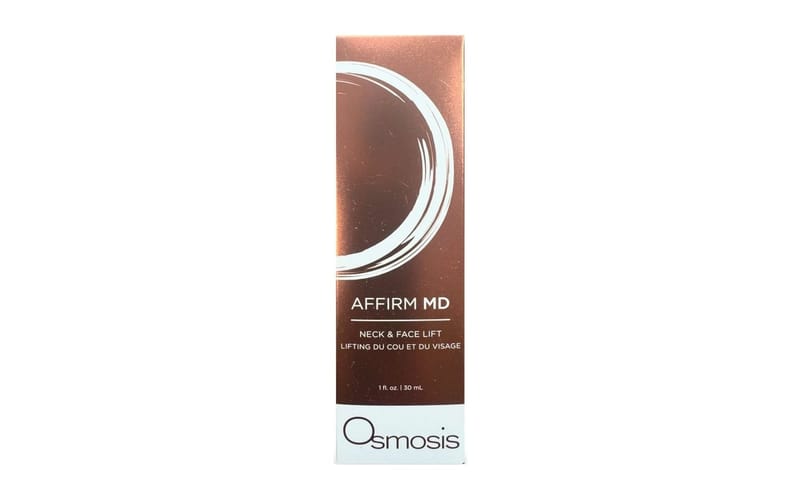
Our shop has two Osmosis products made for this area. Enrich (our Enrich post) is a rich moisturiser for the face and neck, made for dry skin; Osmosis describes it as a night cream. Affirm MD (our Affirm MD post) is a peptide serum for the face, neck and chest, designed to help skin look firmer and smoother (skin consultation recommended). Its printed name, Neck & Face Lift, describes the look, not a physical lift. Neither is a sunscreen. Both contain almond and apricot kernel oils and a macadamia-derived ingredient, so check with your doctor first if you have a nut allergy. Allergy & Anaphylaxis Australia Both also contain essential oils, so test them first. DermNet — Fragrance allergy